

The restaurant
Contagious ambition
Abdo Merjan's arduous journey to Sweden took ten years.
From the war-torn mountains of his homeland Sudan, to the dish mountains in Saltsjöbaden. Vår GårdThe 15th anniversary "backbone"
Abdo Merjan's arduous journey to Sweden took ten years.
From the war-torn mountains of his homeland Sudan, to the dish mountains in Saltsjöbaden. Vår GårdThe 15th anniversary "backbone"
Interview with Abdo Merjans
The morning sun sends beautiful pillars of light through the pergola that opens into Villa Skärtofta. Abdo Merjan squints out over the reed beds that lie wrapped in biblical golden glow.
He passes the dining room, also with a magnificent panoramic view, and gradually reaches his workplace: the kitchen. Once there, he cheers on the white-clad chefs who are bent over their tasks in concentration. A blender whirs in the background. In the scullery, where Abdo begins his workday, stands the dirty result of the morning's kitchen preparations: sunken plastic and steel bowls, a few deep pans with meat juices in the bottom, the meat-covered drill head from the meat grinder, the base of a blender with remains of pumpkin puree.
I get stressed out by the mere sight of this bombardment of dishes and leftovers, but Vår Gård's veteran dishwasher looks at me calmly:
- This is nothing for me. It's calm.
As soon as the “production counter” is ready, Abdo sneaks into the fine dishwashing room, which is a few meters away; that’s where the diners’ plates, cutlery and glasses end up. When there’s a lot to do, they can have 350 guests at lunch. Then you have to be quick.
“I have a system,” he says. “There can’t be a mountain of dishes. It’s about packing the dish racks correctly,” he explains. So that you can fit as much as possible.
After manually rinsing off particularly messy plates, the dishes are fed into an aluminum colossus that resembles a car wash. Pffffffschh, it sounds when the machine starts.
A minute later, the dishes come out clean, via a conveyor belt.
“That’s it: next, go, next, go…
When I tell Karin Lindberg, one of the chefs in the kitchen, that I’m there to interview the restaurant’s dishwasher, she lights up.
“He’s so meticulous, Abbe!” she says.
“Then he’s an environmental policeman!” You know, if a glass jar ends up in the regular garbage, he picks it up right away and puts it where it should be. And if you waste water, you'll hear about it right away.
Very environmentally conscious. He's a real journeyman in that way. It took a while to become one, a journeyman in that sense. In fact, just the journey to Sweden from his country of birth took a whole decade. The hardships began in 1991, when Abdo Merjan came from Sudan, 18 years young.
In his family, they got along regardless of whether they were Muslims or Christians, but in the country as a whole, an increasingly bloody conflict raged between more extreme religious practitioners. Abdo and his family found themselves in a bind. His home village of Kanga, right next to the Nuba Mountains, was constantly in flames. In the end, it was no longer possible to live there.
Abdo made it to Egypt by ferry, together with his friend Aboud. It was exciting to go on a boat for the first time, but above all, it was sad. He left behind his mother and four siblings.
Europe was Abdo's abstract final destination. Where? Yes, somewhere where there was peace, where no one wanted to kill him. In Sudan, he had worked as a baker of both bread and sweets such as baklava and basbosa. His professional skills landed him a similar job in Benghazi, Libya, where he ended up after a short stay in Egypt. From Libya, the journey then continued to Syria, then Russia. Then he ended up in Moldova. There, in the capital Chisinau, Abdo met a beautiful woman in a park.
Language barriers made courtship difficult, but Abdo managed to charm her with the help of the little broken Russian he had picked up. He and the woman, Oksana, fell in love, got married – only to separate shortly afterwards. Abdo was forced to travel further. There were no jobs in poor Moldova. He ended up in Albania and got a job on a construction site, as a painter.
He spent his days perched on Albanian high-rise facades. How fun was that? Literally as fun as watching paint dry. But Abdo Merjan wasn't at the top of Maslow's hierarchy of needs at that point. Boredom didn't exist, survival did.
In Albania he met some Italians who told him about Sweden. It was safe and good for Sudanese there, they said. Abdo had originally planned on England, but the Italians' recommendation made him change his mind. One November day in 2001, ten years after he left Sudan behind, he arrived at a gray Arlanda airport. Abdo applied for asylum and was fairly quickly given both a residence permit and a job.
It was at the Vasa Museum, as a dishwasher. Abdo had never washed dishes before but learned quickly. The profession suited his sense of order, and his need to get things done. The staffing company that ran the restaurant at the Vasa Museum also loaned staff to a conference facility in Saltsjöbaden.
Perfect, Abdo thought. Not just because he lived right next door, in Fisksätra, but because the people in the kitchen were so nice. Here he became a valued part of the gang. That day in 2009, when he was offered a permanent job at Vår Gård, was one of the happiest of his life.
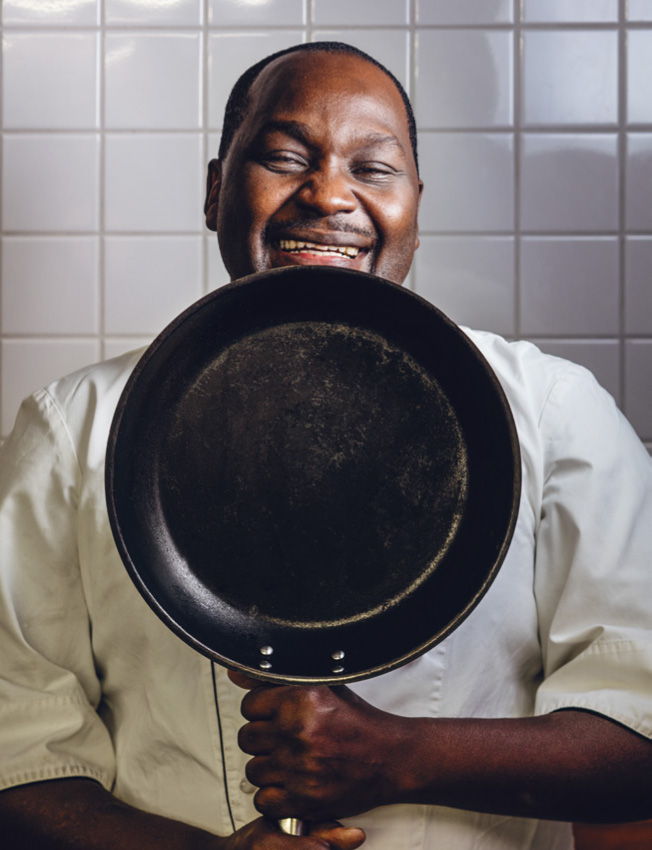
When Abdo Merjan came to Sweden in 2001, he received a residence permit and a job as a dishwasher at the Vasa Museum in just five months. Shortly afterwards, he started working as Vår Gård's dishwasher.
"The people in Sweden gave me respect straight away. Not hatred, like in Sudan."
Text: CHRISTIAN DAUN Photo: BRUNO EHRS
- I liked Sweden straight away, says Abdo as we settle down in a sofa group next to the reception.
- At first the weather was a bit difficult, but it's only three or four months a year, then it becomes okay again. And the people here gave me respect straight away, not hatred like in Sudan.
It's ten o'clock, the hour in the morning between the breakfast rush and the lunch rush when Abdo has time to take it easy. He goes behind the bar and makes himself a latte. "Abbe" is wearing a white chef's coat, black trousers and sturdy work shoes. His hair is neat. A few white spots in his beard indicate that he has turned 44; otherwise he gives a youthful impression: polite and low-key. Next month he will go to Sudan to visit family and relatives, he says happily.
This will be his third trip home since he came to Sweden 16 years ago. His father died of cancer when Abdo was only eight years old, and last year his older sister passed away due to diabetes. The family he has left – his mother and three siblings – still live in Sudan.
- There are still problems in Darfur, but in the northern parts where they live, it's okay. I miss them, I talk to my mother on the phone every week, but I can't imagine living anywhere else but here.
Abdo has had time to settle down properly by now. His wife Oksana, the woman he met in the park in Chisinau, came to Sweden shortly after him. With their first child in her belly. Today they have four mouths to feed. Oksana works as a waiter at the adjacent Grand Hotel and occasionally does extra work at Vår Gård's restaurant. So it happens that she comes in with dishes for her husband.
This year, "Abbe" celebrates fifteen years as a dishwasher at Vår Gård.
- I think it's really nice here, actually great. I'll work as long as I can and get. On Sundays he usually longs for Monday, he says.
- I like everything here, almost more than my own home. There are many who leave Vår Gård and then regret it, who want to come back. I understand that. I ask him to specify what it is that he likes about his work, but Abbe doesn't want to single out any individual aspect. It's the whole thing: coming here and seeing the sea in the mornings, then the chat with colleagues, the banter, and then the work itself, the teamwork that is needed for Vår Gård's kitchen to get through the day.
He loves it. But what about his own skills? What makes him such a valued employee and dishwasher? As expected, I don't get a single self-aggrandizing word from the shy man. To get a better understanding of Abdo Merjan's importance, I return to the kitchen after our chat is over to exchange a few words with those who work with him every day. In the kitchen, it's getting close to lunch service. The kitchen staff is preparing sole with parsley root and white wine sauce. The praise is heaped when I ask them to describe what Abbe means. The veteran at the sink. The machine at the machine...
– There's no one better than Abbe!
– He's worth his weight in gold!
– His heart is in the right place!
– When extra staff come here, they always say: "...and that dishwasher was magical."
Karin Lindberg, the chef who previously described Abbe as an “environmental policeman,” is peeling figs – they’re going to be made into fig jam for the Christmas table – when I come and interrupt. Why is Abbe so important? She considers my question carefully, then she says:
“He doesn’t take shortcuts. The respect he has for his profession rubs off on all of us here. Abbe sets the standard for the entire restaurant.” She smiles.
“I think he’s the backbone of the kitchen.”
The dutiful objects of the tributes have of course already slipped away to the find sink. From inside there, a deafening pffffsch can be heard as the machine starts up. Hopefully he heard it anyway.
About Abdo "Abbe" Merjan
Job: Dishwasher at Vår Gård.
Age: 44.
Lives: Rental property in Fisksätra.
Family: Wife Oksana and four children: 4, 5, 12 and 17 years old.
Best job tip: “Don’t take shortcuts, do everything on time. And in dishwashing, it’s all about how you load the dishwasher.”